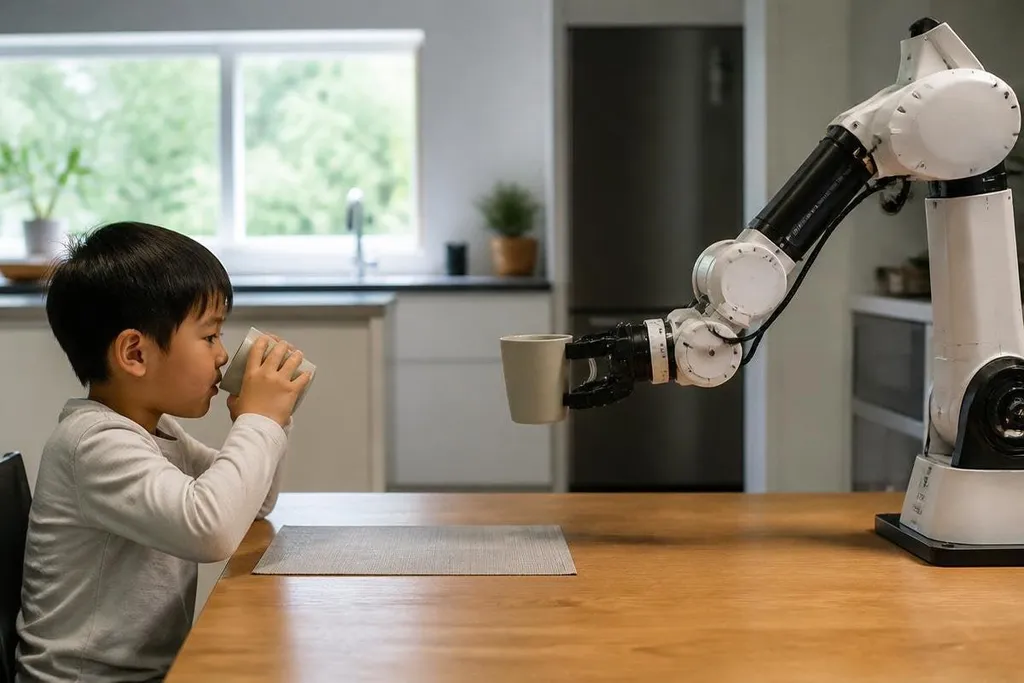
A child can learn to use a cup after seeing a few examples. A robot may need sensor data, repeated trials, and a clear scoring rule before the same task works reliably. That gap explains why robot learning needs a different plan from human learning.
- People bring prior knowledge to new tasks.
- Robots turn sensor input into actions through software.
- A task that works in training can still fail in a real room.
People learn with context
Human learning starts with more than what the eyes and ears receive. A person already knows that a cup is an object, that liquid can spill, and that a table usually stays still. Those facts help them make sense of a new task before they try it.
People also learn from language, touch, memory, and other people’s actions. A short instruction can change how someone approaches a task because the instruction connects with knowledge they already have.
This lets people learn from small amounts of direct experience. A person may see one handoff, try it, notice a mistake, and adjust the next attempt. The brain fills in much of the missing detail.
Robots learn from signals
A robot starts with sensors and software. Cameras may record images, force sensors may measure contact, and joint sensors may report the position of each motor. Software then turns those readings into a move.
The robot needs a way to judge that move. In supervised learning, people label examples and the system learns to match those labels. In reinforcement learning, the system receives a reward or penalty after an action and changes its next choice.
A robot arm moving a box, for example, may need to learn where to place its gripper, how much force to apply, and when to stop closing its fingers. Each part depends on the object, the camera view, the arm’s position, and the surface under the box.
That makes the learning process tied to the body. A model trained on one arm may behave differently on another arm with different motors, cameras, or joint limits. The software has learned a relationship between data and hardware, not a general idea of “pick up a box.”
The real room changes the task
Training data often comes from a fixed setup or a simulator. A simulator can run many trials without breaking a gripper, but its virtual objects may not behave like physical ones. Friction, lighting, cable movement, and small changes in object shape can alter the result.
This gap is called the sim-to-real problem. Engineers reduce it by adding more varied training scenes, using real robot data, or letting the robot adjust its actions during operation. Each choice adds time, cost, or safety work.
A human can often recover when a cup moves a few centimeters. A robot needs sensors and control software that can detect the change, update the planned motion, and keep the arm away from people. That recovery must be learned or programmed before the machine faces the same event.
A changed work cell can expose what a robot has really learned. If the shelf height, floor surface, or lighting shifts, a system that picked objects well may fail because it learned one scene rather than the task. A dated report on Robot24.com can give you a named system and test setting to compare before the next section examines the data behind the result.
Why data quality matters
More data doesn't fix every learning problem. If the examples leave out dark objects, blocked views, or failed attempts, the robot may perform well only under clean conditions.
The labels matter too. A dataset that marks an object’s center may help with location, while a task that needs contact force requires different information. The training target has to match the action the robot must take.
Human learning has limits as well. People get tired, forget steps, and vary in skill. Robots can repeat a motion without fatigue, yet they need careful setup and checks before repetition becomes useful.
I think the clearest way to judge a robot learning claim is to ask what changed outside the training setup. A video of one successful run tells you less than a record of failures, recovery steps, and results across new objects.
A practical check for robot learning claims
Use this list when a company or research team says a robot has learned a task:
- Task: What exact action did the robot perform, and what counted as success?
- Data: Did the system learn from simulation, recorded examples, live trials, or a mix?
- Hardware: Which robot, sensors, gripper, and software version produced the result?
- Changes: Did the robot face new objects, lighting, layouts, or surfaces?
- Limits: What failed, how often did it fail, and could a person stop the motion safely?
These checks separate a learning method from a polished video. They also tell you whether the result could fit your own lab, factory, or service task.
The next useful step in robot learning is better transfer: systems that carry a skill from one setup to another while showing their limits clearly. Until that happens, treat human-like learning claims as a test question, not a finished result.